
RESPONSE TO ECONOMISTS AND THE BENEFITS OF LLMS IN FINANCE
Economists from the University of Oxford—Hongwei Mo and Shumiao Ouyang—claim that LLMs will function as tools that help improve the efficiency of workers—instead of replacing them, workers may become more productive. The authors support their view by explaining that gen AI can perform tasks such as “prediction, information extraction and semantic analysis, task automation, and data generation.” (Mo and Ooyang 513) This suggests that many present responsibilities can now be more efficient by completing using AI. However, that does not mean there are no limitations with using AI, as Mo and Ooyang also recognize that “while LLMs are better at gauging risks than humans, they exhibit behavioral biases in predictions, such as over-extrapolating past returns.” (Mo & Ooyang 518) While AI can improve efficiency, it cannot fully replace human judgment due to its tendency to rely too heavily on patterns in past data. This finding suggests that using LLMs would still require human involvement to ensure accuracy and reliability, and relying solely on AI could lead to flawed conclusions if those “behavioral biases” are not properly corrected. This is especially important for new graduates looking to work in financial services such as private credit, since entry-level roles may shift from performing basic analysis to overseeing and validating AI-generated outputs.
While I do agree with Mo and Ooyang’s claim that LLMs will significantly improve efficiency in finance, this increased productivity is also the exact reason why demand for entry-level workers may decline. If AI systems are capable of performing repetitive analytical tasks faster and at a lower cost, firms may no longer need to hire as many junior analysts to complete those responsibilities. Though, the economists point out that AI still contains important limitations and “behavioral biases,” meaning firms cannot rely entirely on automated systems for complete decision-making. This means that AI is more likely to restructure entry-level roles by shifting responsibilities towards data checking and oversight on LLMs.

RESPONSE TO LABOR MARKET RESEARCHERS AND THE DECLINE OF ENTRY-LEVEL OPPORTUNITIES
While some economists argue that LLMs will primarily improve efficiency, researchers are concerned about the effects of AI on new graduates. Maxim Massenkoff and Peter McCrory are economic researchers at Anthropic, an artificial intelligence company that specializes in AI safety and development. Their research responds to concerns about how LLMs may reshape labor markets, especially for younger workers entering industries heavily exposed to AI integration, such as the finance sector. The research paper shows a figure that illustrates job tasks that LLMs could theoretically perform and its actual capabilities (Massenkoff & McCrory 6), and categorizes business & finance as one of the highest in theoretical AI exposure. Although the chart also shows that real-world adoption remains lower than AI’s theoretical potential, the gap between actual and predicted will likely narrow as technology continues to develop and firms become more comfortable integrating AI into workflows. This trend is shown credible as researcher Mustafa and Aysan analyze the increasing use of autonomous AI systems in finance firms, and found that “non-zero prevalence [of AI deployments] appears in 2024 (0.4%, 2/500) and then rises further in 2025 (1.6%, 8/500)” (Mustafa and Aysan 88). This implies that financial firms are gradually becoming more willing to integrate advanced AI systems, and the exponential growth of adoption suggests that AI may become increasingly normalized within finance operations over time.
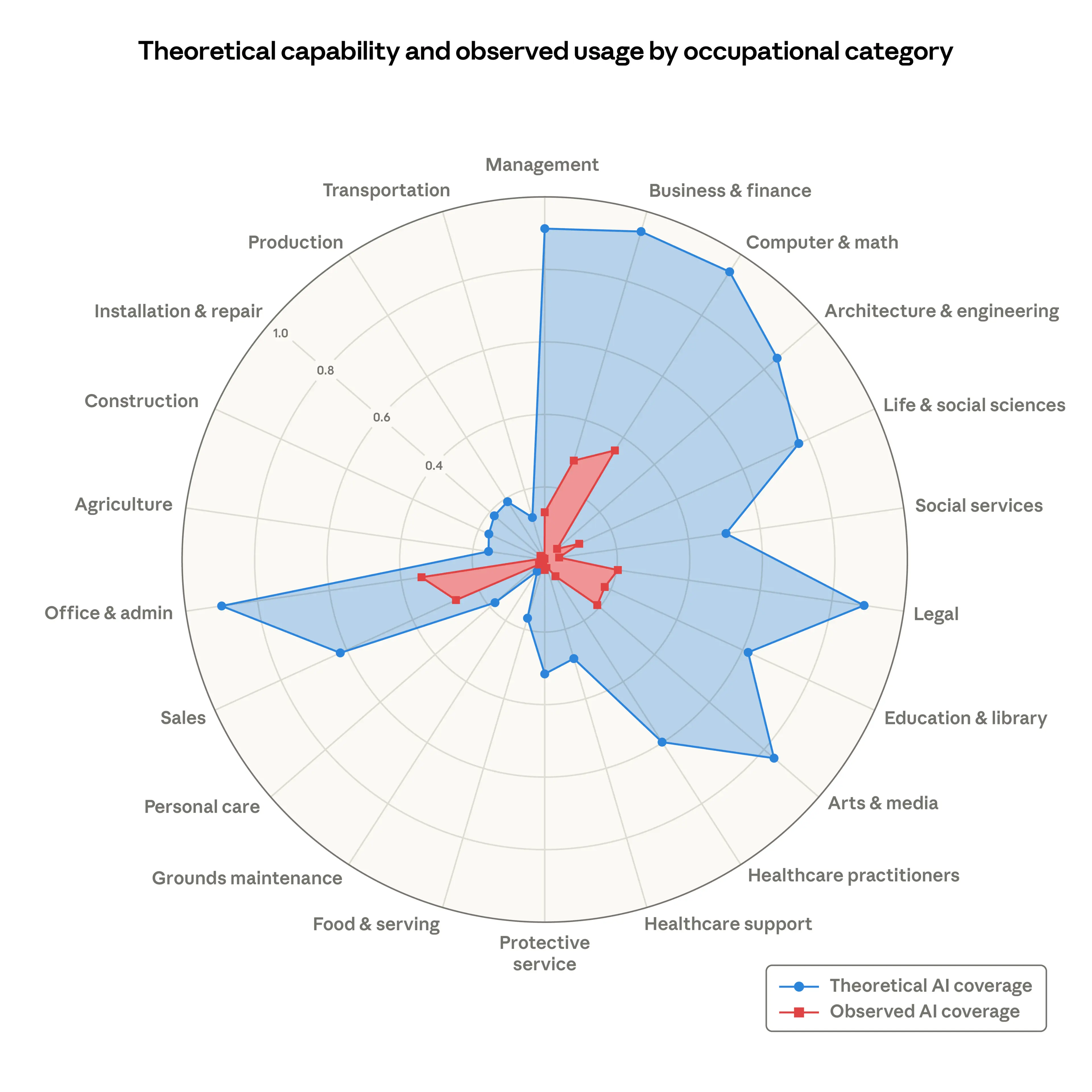
I agree with the researchers’ concerns because the increasing integration of AI creates strong financial incentives for firms to reduce the size of entry-level teams. Since AI systems can process information more efficiently and at lower costs than junior employees, firms may choose to rely more heavily on automated systems for repetitive analytical work. However, since AI could still make mistakes like “behavioral bias,” and will still require workers capable of interpreting outputs, identifying errors, and applying human judgment.
RESPONSE TO SCHOLAR ON FUTURE SKILLS EXPECTED FROM NEW GRADUATES
Wylie Page is a graduate student from the Honors College in Oregon State University with a degree in business administration and business, and her research focuses on how artificial intelligence is reshaping hiring practices in entry-level finance careers. In her thesis, “Identifying skill sets for entry-level finance jobs: analyzing the impact of AI on hiring practices for newly graduated students,” she argues that LLMs are transforming not only the availability of entry-level finance jobs but also the skills employers increasingly expect from new graduates, with “65% from large firms mentioned AI-related skills… such as Python, SQL, and machine learning” (Paige 25). This finding suggests that finance firms are beginning to prioritize employees who can work alongside AI systems, and future junior associates will likely be working with AI by supervising automated outputs, interpreting data, and identifying mistakes that algorithms may overlook. This expectation is reinforced by García-Llorente and Olmeda, as these researchers state that financial institutions must “provide meaningful, comprehensible explanations for the operation and outcomes of AI systems” (García-Llorente and Olmeda 7). Since AI systems may still produce errors, biases, or unclear reasoning, financial institutions will continue needing workers capable of understanding and explaining generated outputs.